


I’m not claiming that social media is all good. Those of you who follow me on ‘the other platform’ will know that my major beef with Musk’s freedom of speech (but not reach) mantra is that certain political views are too easily suppressed. But, despite this, the collective voice of the people on these platforms make politics and politicians seem increasingly out of touch and utterly lacking in self-knowledge. Not to put too fine a point on it, politicians are loathed and mainstream media organisations are seen as lying propagandists. What’s left is social media.
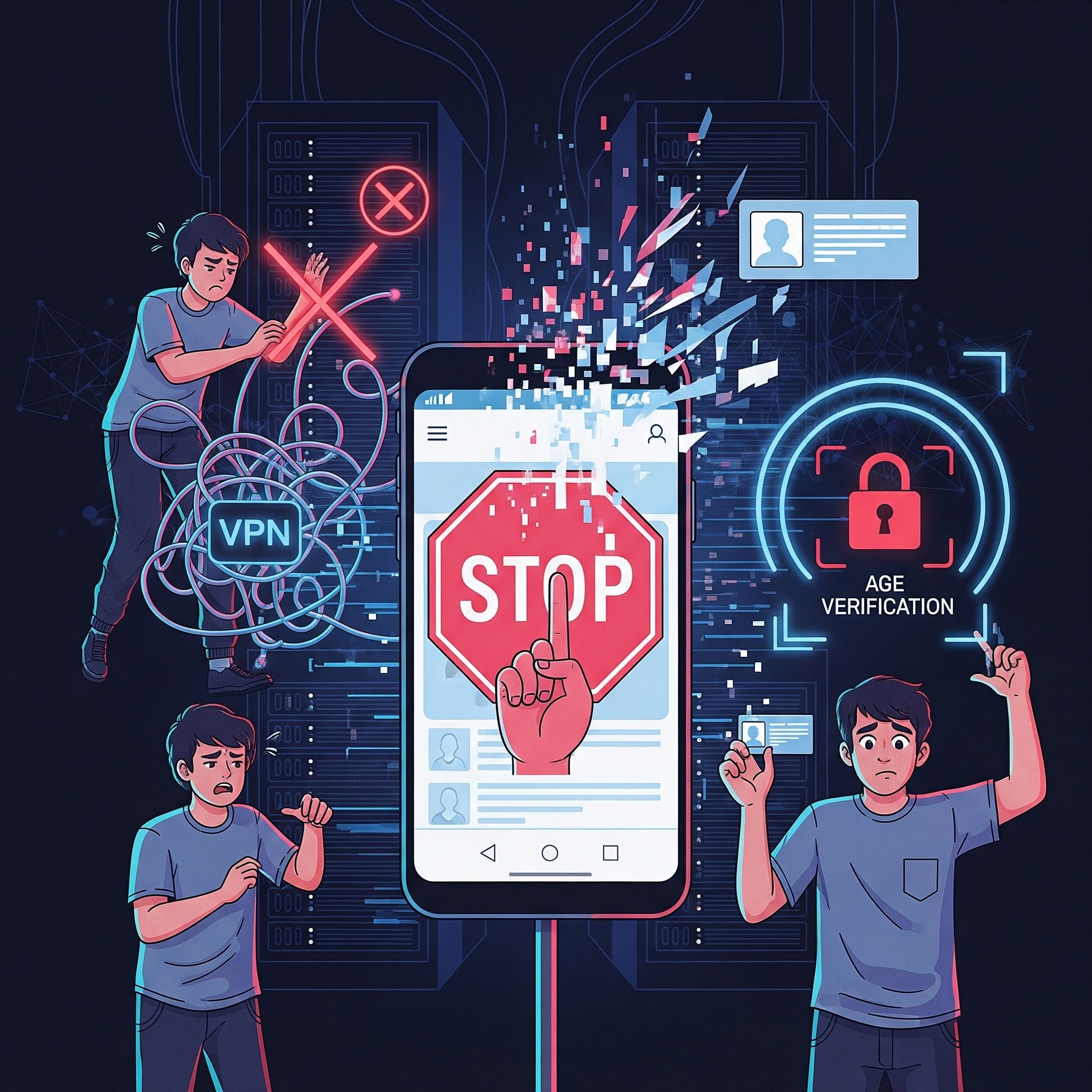
This is the primary reason why the government - and most of the mainstream political parties - want to curb access to the internet. Social media, within seconds, undermines every government policy or pronouncement - and every politician peddling them. The government is unable to control what people say on social media so they see reduction of participation as a major policy plank. Ditto the “opposition parties”.
Of course, the government is claiming that restricting social media access is all about child protection. This is utter nonsense. Social media has been around for around 30 years. My own kids, both of whom are in their late 20s, have been routinely using social media since they were in their early teens. Smart phones (and app stores promulgating social media apps) have been around since 2007.
On the plus side, the UK government’s plan to ban under-16s from mainstream social media platforms by Spring 2027 faces severe implementation hurdles.
Australia provides a handy case-study (having banned under-16s using social media platforms in December 2025) and indicates that the policy will likely fail to curb usage because of widespread technological workarounds, strong incentives for platforms to maintain user bases, and fierce opposition from privacy campaigners.
The Australian experience shows massive circumvention. Research data shows that nearly 70% of Australian children retained or created new social media accounts despite the ban. Because the desire to connect with peers is strong, teenagers easily bypass age-verification gates.
The data also shows a shift to darker alternatives. Banning mainstream sites has fueled a spike in downloads for lesser-known, unregulated, or decentralized apps. This pushes younger users out of curated environments and into deeper online corners.
And, of course, VPNs and technical workarounds are available. Teenagers quickly turn to Virtual Private Networks (VPNs) and peer-to-peer sharing to spoof their locations or bypass age restrictions altogether.
Of course the likely response from social media platforms to the proposed UK legislation is also entirely predictable. The platforms rely on self-declaration or friction-based age checks (like photo ID matching or facial estimation). Historically, they do not aggressively purge underage users as it directly hurts engagement metrics and ad revenue.
Also SM companies might argue that age-gating should be the responsibility of app stores (Apple App Store or Google Play Store) rather than implemented at the individual platform level.
There will also be regulatory challenges. Regulators like Ofcom are finding that accurately distinguishing a 15-year-old from a 16-year-old is highly difficult. This makes creating watertight enforcement metrics nearly impossible without locking out legitimate adult users.
But the greatest hurdle will be pushback from internet freedom campaigners and ordinary adult users who will baulk at having to provide personal information or facial recognition scans to tweet or post photos from Granny’s birthday party.
Aggressive age assurance policies such as facial scanning or submitting government IDs (via services like Yoti) creates massive privacy risks, normalises mass surveillance, and puts minors’ biometric data at risk of breaches.
And the proposed legislation is effectively internet censorship that will ultimately end anonymous account creation for all users in the UK, altering the foundational freedom of the internet.
If you enjoy The New Era you may wish to read my debut novel, South of Market. Many subscribers have read it and enjoyed it. I’m also thinking of writing a sequel. More information is here.
MiriAF has been writing on the same topic and has arrived at a similar conclusion - that the policy is all about ending anonymous account creation. https://miri.substack.com/p/identity-crisis
The "Online Safety Act" is an irrational, ill thought out and unnecessary piece of nonsense...
Today, I was asked to verify my maturity regarding a Substack piece on a subject that did not require such nonsense three days ago...and in another medium, either...I'm an old Luddite, and I abhor censorship mis-applied...
It is the wish of the population that there should be unfettered communication...but that drives censorship...Without one, the other cannot exist...