


In this second article for The New Era by Luc Lelièvre, the Canadian Sociologist, he argues that rigidity makes it difficult to understand the purpose of corporations and public institutions.
Read Part 1 here:
When Truth Drifts

Modern societies often assume that more information automatically leads to better decisions.
Part 2: Rigidity…
There is a strange paradox at the heart of institutional life.
Institutions are created to solve problems. They exist to coordinate action, impose order, preserve knowledge, and make collective life more predictable. Yet over time, they often begin to reproduce the very problems they were meant to solve.
Bureaucracies designed to ensure fairness become machines of delay. Schools created to transmit knowledge become increasingly preoccupied with credentials, conformity, and social reproduction. Public institutions established to serve citizens become preoccupied with procedures, internal legitimacy, and their own survival.
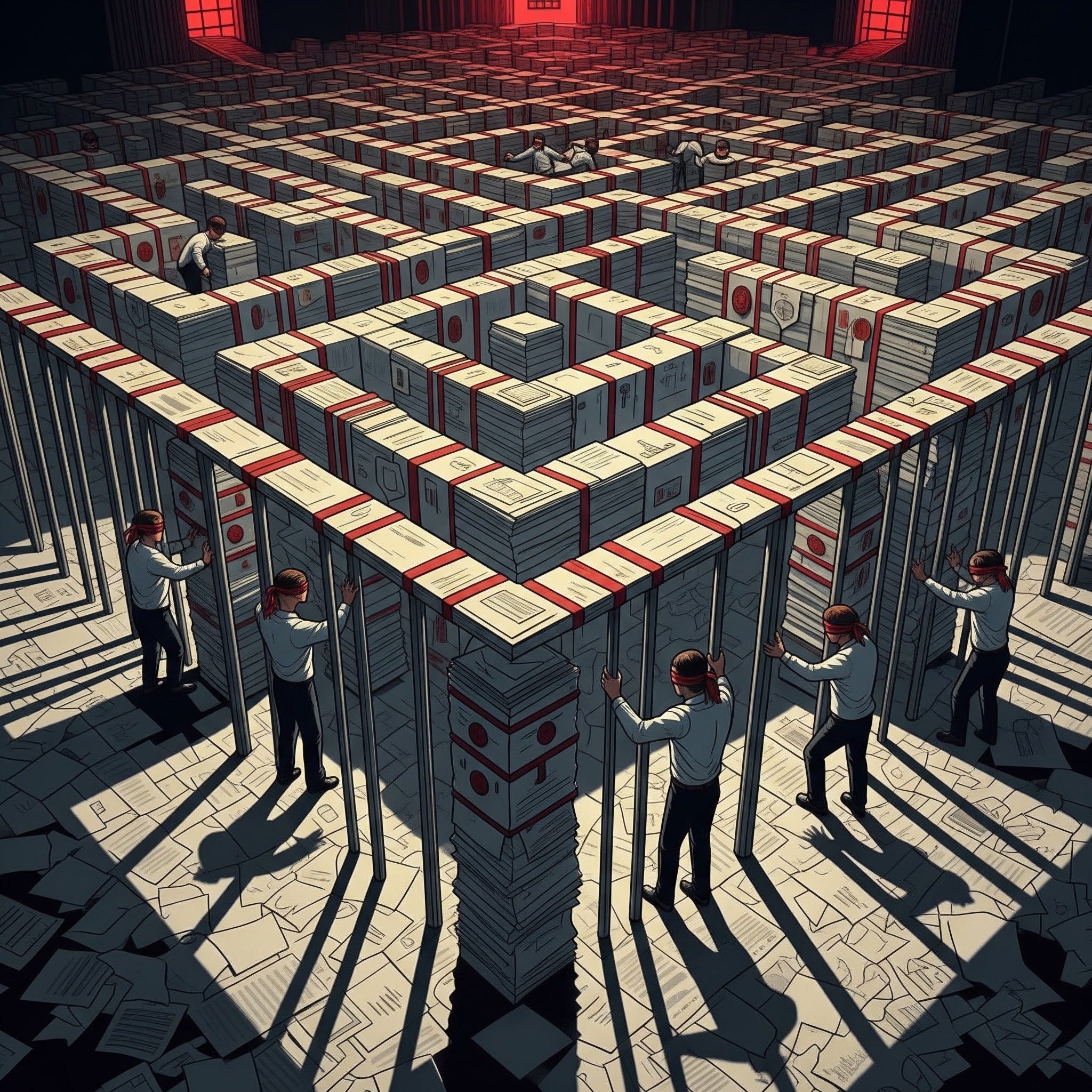
Why?
The usual answers are familiar: incompetence, corruption, poor leadership, political capture, or, at times, conspiracy. These explanations may occasionally be correct, but they miss something deeper.
Institutions can become dysfunctional without anyone deliberately choosing to be dysfunctional.
The problem is structural.
The first problem is rigidity. Once an institution has established rules, procedures, hierarchies, professional norms, and categories, these arrangements take on a life of their own. They may have been created for a specific purpose, but eventually preserving the arrangement becomes a purpose in itself.
The institution begins to protect not only its mission but also its structure.
This is the old danger Max Weber identified in his famous image of the “iron cage.” Bureaucracy is extraordinarily powerful because it replaces personal whim with predictable rules. But the same rules that create order can eventually become detached from the purpose they were meant to serve.
The procedure survives. The reason for it disappears.
At that point, following the rule becomes more important than achieving the original objective. A person who finds a better way to solve the problem may even be treated as the problem.This is how institutions begin to conflate obedience with virtue.
But rigidity alone does not explain institutional failure. The deeper problem is a blindness.
Institutions do not merely resist information. They also determine what counts as information.
Organizations operating in the same environment tend to become increasingly similar. Universities imitate universities. Hospitals imitate hospitals. Government agencies imitate government agencies. This does not necessarily happen because a particular model works. Often, it happens because the model appears legitimate.
The question gradually shifts.
Instead of asking, “Does this work?” institutions begin to ask, “Is this what institutions like us are supposed to do?”
That shift is crucial. Legitimacy begins to replace effectiveness.
Once that happens, inconvenient evidence becomes difficult to process. Information that fits the institutional categories is recognized as meaningful, while information that does not fit them is ignored, reclassified, delayed, or dismissed.
The institution does not necessarily consciously reject reality.
It may simply lack the categories required to see it.
This is where the problem becomes truly human.
People who spend years in an institution gradually adopt its way of seeing. Its rules begin to feel natural. Its hierarchies become common sense. Its assumptions become invisible precisely because everyone shares them.
A senior administrator may be unable to imagine a different organizational structure not because she lacks intelligence, but because the existing structure has become the horizon of what seems possible.
A bureaucrat may recognize that a procedure is absurd yet still defends it.
A professional may recognize that a system is failing yet continue to speak its language.
This is not necessarily hypocrisy. It is often socialization.
Institutions produce people who can operate effectively within the institutional world while becoming progressively less able to see the world outside it.
That is systemic blindness.
And even when the blindness is finally recognized, change remains extremely difficult.
Institutions are built layer upon layer. Past decisions create expectations, investments, careers, regulations, professional identities, and entire networks of dependence. The longer a structure endures, the more difficult it becomes to abandon - not necessarily because it is good, but because so much has been built around it.
This is why inefficient arrangements can persist for decades.
The cost of changing the system exceeds the perceived cost of tolerating its failures.
When pressure finally becomes impossible to ignore, institutions often respond symbolically by creating new committees, reports, offices, slogans, and accountability mechanisms.
The appearance of change can become a substitute for real change.
The structure survives by adapting cosmetically.
Genuine transformation is much rarer. It usually requires something more disruptive: a challenge to the assumptions that the institution uses to understand reality.
This is why replacing a leader often results in less change than expected. The new leader enters the same structure, inherits the same categories, relies on the same networks, and is quickly socialized into the same logic.
The institution absorbs the individual.
Real reform, therefore, requires more than new rules. It requires the institution to become capable of questioning the assumptions that structure its own perception.
That is an extraordinary demand.
Institutions must learn to examine the categories they normally use to analyze everything else.
They must ask not only whether we are following the rules.
They must also ask:
What if the rules themselves are keeping us from seeing the problem?
This is the central difficulty of institutional life. The mechanisms that create stability also produce rigidity. The structures that produce legitimacy can weaken responsiveness. The shared assumptions that make collective action possible can eventually render alternative possibilities invisible.
Therefore, institutional dysfunction is not always accidental.
Sometimes it is the predictable result of institutional success.
The institution becomes stable enough to survive its failures.
And when that happens, the real challenge is no longer to reform the institution.
It is to make the institution capable of self-reflection.
Luc Lelievre is a Canadian sociologist and critical anthropologist with advanced doctoral training at Laval University. His peer-reviewed work has appeared in Anthropologieet Sociétés and Les Cahiers de géographie du Québec. His research focuses on institutional governance, academic freedom, and the systemic effects of bureaucratic drift. He writes from Poularies, Quebec.
I have lived in Brazil for nearly 40 years. It is a bureaucratic nightmare. Every word of your article resonated. The system rules. Never ask "Why?"
Beautiful reading Luc . Thank you.