


Some commenters on my piece yesterday (not on this platform but on others) seem to be under the impression that I was defending social media companies and had an expectation that they would ‘do the right thing’ in terms of protecting the rights of children, or whatever. I was not making any such claims at all. And I couldn’t care less what ‘protections’ they make - or so-called governments demand - in terms of controlling/patrolling free speech.
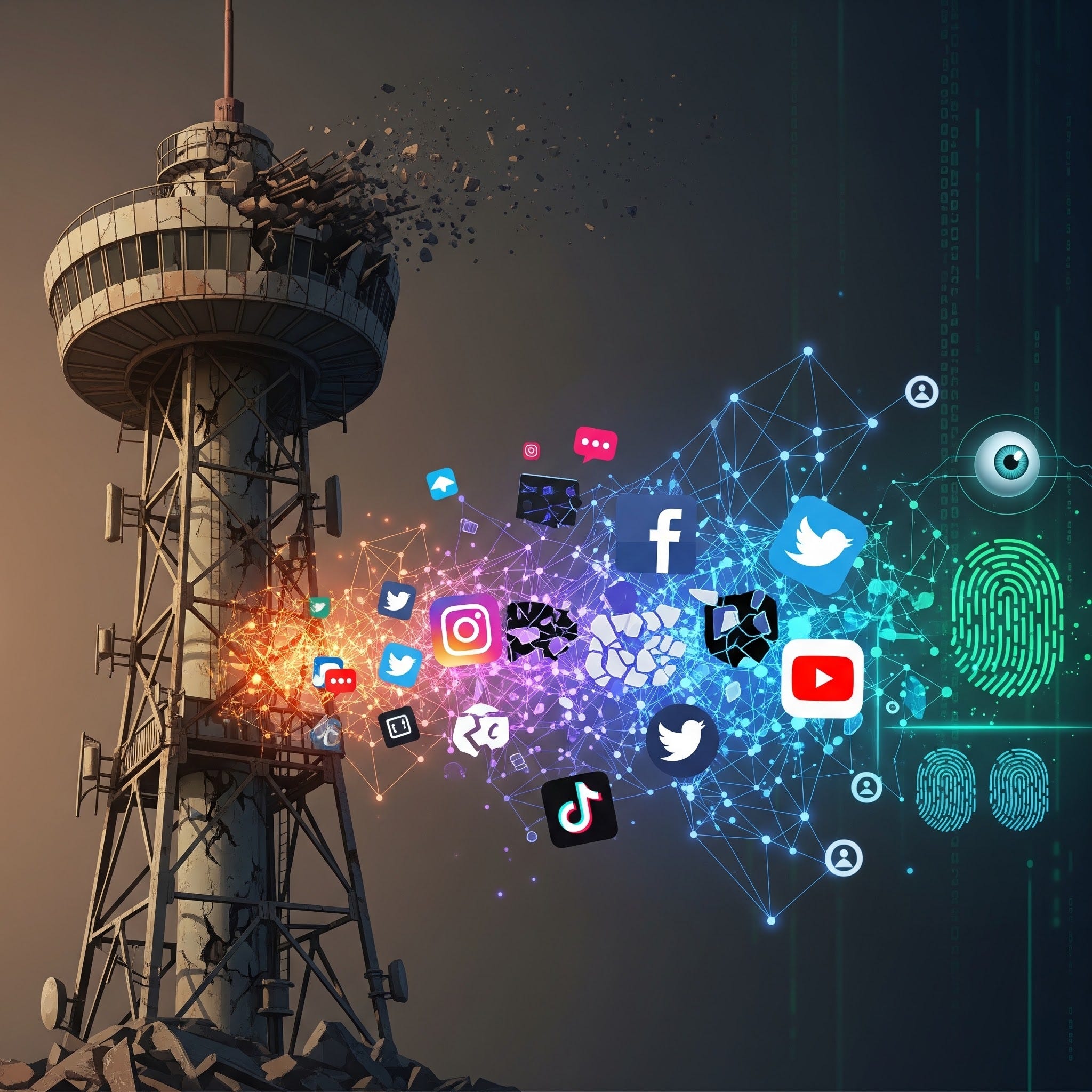
Let me explain exactly what I mean by going back to some basics. Let’s consider what media is and how it differs from social media. Then I’ll explain, again, why the proposed digital ID proposals are extraordinarily sinister (but doomed).
First of all, let’s consider the difference between media and social media. Let’s ask an AI bot to define the difference. This, courtesy of Gemini:
Media has historically served to inform, educate, and shape public opinion, acting as a bridge between events and the public. It establishes societal norms and holds institutions accountable. Social media differs fundamentally from traditional media by decentralizing this flow of information. It shifts the model from one-way broadcasts to interactive, two-way conversations.
Clearly it was inevitable that, with a pervasive, near-universal, free and open Internet that the balance of power would shift away from centralised, media-controlling, organisations (like the government) to individuals.
Note that in Gemini’s amalgam definition of ‘media’ it notes that it has a role to ‘shape public opinion’. And that is what it has done, and continues to do. But its influence is waning. In fact, it’s plummeting.
Even the BBC has been forced to admit the obvious.
Also, the role of the media, as per Gemini’s definition, of establishing societal norms and holding institutions accountable, is laughably absurd and elitist. But it’s a very accurate portrayal, for example, of the BBC’s positioning - as evidenced by this cringe-worthy video produced by the organisation, claiming that it is a single source of truth.
But alongside this collapsing trust (and collapsing licence fee revenue) is a growing reliance on social media for news content. But, remember, social media is not media. There is no centralised control (or shouldn’t be). Rather, people ‘get their news’ from social media by seeking out the opinions of their peers, their favourite ‘influencers’ or seeking network agreement for their own opinions (as I’m doing here, now). And, in the face of this, the traditional media (tell-sell, broadcast approach) just doesn’t cut it any more.
The BBC realised some time ago that it was never going to survive in the face of individual free thinking. That’s why few, if any, news articles on the BBC website are open for comment. But it’s also why the BBC was quickly scrambled during the fake pandemic to create an international censorship network that included all of the main social media platforms: the ironically titled “Trusted News Initiative”.
The organisation, or rather its spook handlers, realised that it was failing to control the narrative around the faked pandemic given the widespread availability of an opinion promulgation network (called social media). Therefore, it set about creating a censorship nexus.
The result, however, was widespread disaffection from the social media platforms that retained traditional media’s funding sources (advertising revenue). Customer disaffection isn’t a great business model so the social media companies rapidly rebranded after the Covid fiasco. In the case of Twitter it was ‘acquired’ by the same people and institutions that owned it before. But the rebranding included the idea of ‘freedom of speech, not freedom of reach’ to appease the automated digital advertising networks.
But after the COVID debacle the spooks are left with a dilemma. The ‘media’ island of Newspeak is getting smaller and less well funded. “News” and network anchors who were associated with the unrelenting propaganda around the “pandemic”, “climate change” and “culture wars” are slowly, but surely, being exited (often because of their arrogance, perversions or both). Just yesterday the BBC announced thousands of job cuts and vast cost savings - including the exit of Amol Rajan from the Today programme (it’s quite astonishing that the axing of just one presenter from one radio programme is highlighted in a story about huge cost-savings).
But, given this waning in the importance of media designed to ‘shape public opinion’ what’s a spook network to do?
By definition, social media companies do not publish. They provide a platform for people to publish, and advertisers to advertise and governments to shape public opinion. By attracting people (consumers, citizens, employees, PR types, commentators, journalists, politicians) to the platform they get to sound off about stuff. Or publish videos. Or photos. Or opinions. But there’s no central organisation or control of all this stuff. It just is. It’s a medium of exchange. And it attracts all sorts. Good and bad. And there are lots of competing platforms. Some platforms are effectively run by the state or technocratic super-state. Some are genuinely independent (although they tend not to last, or are bought-out).
So the only means available to governments and their spooks to re-establish control is to have total central intelligence of what’s happening on the networks. That requires each and every user to be identified. It also requires the building of vast data surveillance networks (and data centres) and also the promulgation of content from approved influencers with vast reach.
The lesson that central intelligence has learned from traditional media and is currently applying in social media is that big influencers must be seen to be mavericks who organically emerge. However, this is tricky to achieve when the ‘model’ they have been using is to migrate well known traditional media personalities (like Tucker Carlson or Russell Brand) over to the world of social media. Hence Carlson moves from Fox to Twitter. Or Piers Morgan is repositioned as a maverick ‘thinker’ and faux conspiracy theorist (look at his repositioning from vaccine peddler to sceptic). Russell Brand’s rapid adoption of Christianity is in no small part based on the observation that supposedly organically emergent social media influencers (like James Delingpole) are often Christian. This is the modus of central intelligence in the social media era…they use actors to ape crowd-created influencers.
The problem they face, however, is that people have an uncanny ability to detect wrong’uns, actors, and placed ‘talent’. Moreover, it’s often the case that anonymous accounts can achieve huge reach organically.
This explains why such efforts were made during the purging period from 2020 to around 2022. And it also explains why, starting with Australia, all members of the Five Eyes network will use the excuse of ‘child protection’ to implement control over social media platforms. Australia took the lead in 2025. Now the UK and Canada. Eventually the US states will do it too. And NZ no doubt. Slam dunk.
The only reason ‘parents’ apparently support it is because the governments make it appear so by commissioning rigged studies.
However, all of the efforts will fail, for the reasons I alluded to in my post yesterday. People will simply not agree to digital ID gate-keeping to maintain their social media accounts. Therefore, the social media platforms won’t try. As argued by MiriAF, yesterday, they’ll probably target anonymous accounts primarily, then give up. And age-policing of under-16s will come unstuck because of GDPR and, ironically, distrust of social media companies holding personal data. And the widespread use of VPNs.
In my view, it’s much more likely that the attempt to make society a digital-prison ship is about to hit a big iceberg. The circular economy that is the so-called ‘Magnificent 7’ Tech Bro companies, is teetering. So don’t let the latest spook strategy unsettle you too much. This particular good ship DigitalID is full of holes. But another one might be coming soon.
I'm half expecting the resurgence of analogue forms of doing business, community, building etc. People are increasingly pissed about having zero privacy, zero control over what they rightly believe is theirs but are increasingly forced to pay rent to access, software and equipment that is bricked by suppliers, software changes that cause daily headaches. Wtf. With analogue it's either there or it isn't. Same with real friends, contacts, associates. They don't disappear when the electricity goes off.
Astute comment and observations as per usual. Thank you Jeffrey Peel.