


A guest post by Martina Willis
Martina and I have known each other for several years and share a common world view about many issues - but especially about the lurch to corporatism and authoritarianism over the last few years. Martina sent me this article a few weeks ago and asked if it resonated at all, and might be suitable for The New Era.
It’s essentially an extended essay about how “individuals become increasingly dependent on large systems for things they once possessed some capacity to provide, influence or negotiate themselves”. So it clearly resonated immediately. This is the dilemma we face: how do we wrest back control, or create a new economic system, when we have accepted, so readily, what centralised corporatism has provided?
Martina introduces the idea of the “spiral economy”. Her initial article was more algebraic, econonometric even. Went way over my head. But this prose version she prepared for me and this site. I hope you enjoy it. It’s presented here unedited and in full. And I know that Martina would welcome comments. So they’re open. JP
A Different Question
We have spent an extraordinary amount of time arguing about which economic system is right: capitalism or socialism, markets or government, growth or degrowth, centralisation or decentralisation, individual freedom or collective responsibility.
I have begun to wonder whether we are arguing one level too low.
Perhaps the deeper problem is not primarily which mechanism we choose, but the architecture through which resources, money, power, information and human capacity move.
Look at many of the systems around us and a remarkably similar pattern appears. Resources are extracted, transformed, consumed and discarded. Money moves through productive activity and tends to accumulate. Authority is delegated upwards and has a tendency to remain there. Institutions created to solve a problem can survive long after the original problem has changed. Individuals become increasingly dependent on large systems for things they once possessed some capacity to provide, influence or negotiate themselves.
The institutions may become more capable while the people underneath them become less so.
That observation became the starting point for what I call the Spiral Economy. It is not an argument against markets, governments, companies, wealth or technology. Nor is it another proposal for an ideal society. It begins with a much simpler question:
Can we create larger and more capable systems without progressively making the smaller systems from which they are built weaker, more dependent or less free?
The Strange Thing About Scale
Human beings create higher-order systems because they are extraordinarily useful. One person cannot build a railway network. A household cannot manufacture semiconductors. A village cannot operate an international payments system. A small company cannot necessarily fund research costing billions.
We cooperate because relationships create capabilities that none of us possess alone. There is nothing inherently wrong with scale. The interesting question is what happens to the participants when scale emerges.
Consider education. A child enters an educational system because teachers, institutions, other students and accumulated knowledge can provide something the child cannot provide alone. But the ideal outcome of education is not a human being who becomes permanently dependent upon the teacher. It is precisely the opposite: the student should emerge more capable.
Healthcare has a similar logic. The purpose of a hospital is not to create lifelong dependence upon the hospital. Where possible, it should return the patient to life with greater functional capacity.
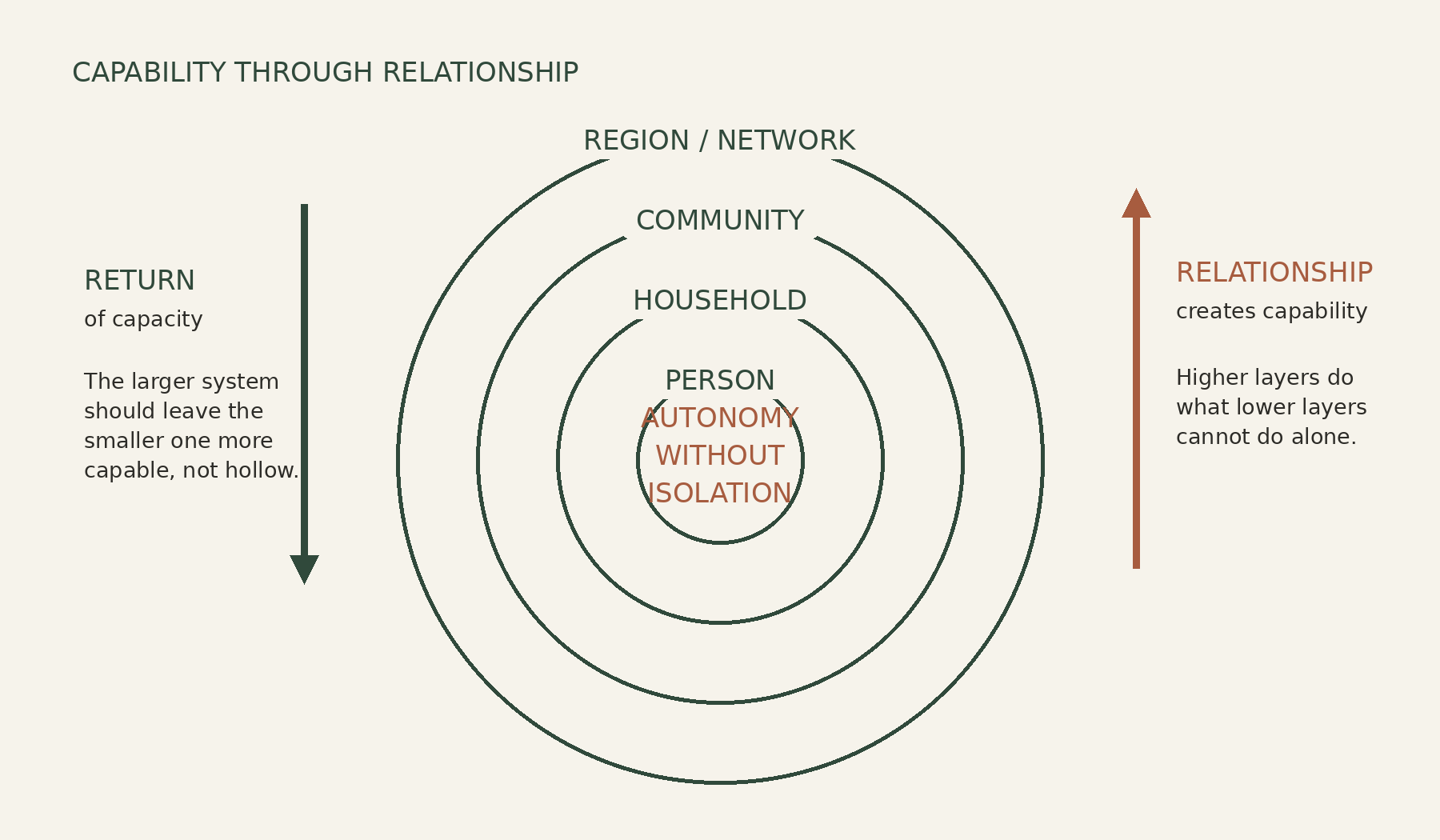
The same principle can be applied to companies, communities, governments and economies. A higher-order system justifies itself not simply because it has become powerful or efficient, but because the capability created through coordination ultimately returns capacity to the systems participating in it.
Good systems do not merely accumulate capacity. They circulate it.
Autonomy Without Isolation
This leads to what may be the most important distinction in the whole idea. Autonomy is not the same as independence.
I am not proposing that every household grow all its food, generate all its energy, educate its children, manufacture its medicines and disconnect from society. That would simply replace dependency with isolation.
Instead, imagine a household that possesses enough resilience that participation in larger systems becomes increasingly voluntary rather than existentially compulsory.
If losing one salary immediately means losing shelter, food, energy and security, a person’s theoretical freedom may be considerable while their practical freedom is very small. A more resilient baseline creates optionality.
The person can still work. Trade. Build companies. Participate in markets. Specialise. Cooperate. But they do so from a stronger negotiating position.
Autonomy without isolation: strong enough to choose relationships, but not so isolated that relationships become impossible.
And the principle scales. A household can retain meaningful autonomy while belonging to a community. A community can retain meaningful capacity while belonging to a region. A region can participate in a state. A state can participate internationally. The existence of the larger system does not inherently require the smaller one to become hollow.
Capital Is Not The Enemy
This also changes how I think about capital. It is easy to make accumulation itself the villain. But large concentrations of capital can create extraordinary things: factories, infrastructure, scientific research, new medicines, energy systems and technology. Some capabilities simply require scale.
So the more interesting question is not, ‘How much capital has accumulated?’ It is, ‘What is the capital doing?’
Does it continue circulating through productive transformation, creating knowledge, infrastructure, businesses and future capability? Or has it become primarily extractive, pulling capacity out of productive systems and terminating the flow?
The Spiral Economy therefore distinguishes accumulation from circulation. A billion euros continuously generating new productive capability may be considerably more regenerative than a much smaller amount of capital that simply extracts rents from an increasingly fragile underlying system.
Distribution still matters. But circulation tells us something distribution alone cannot.
Perhaps Growth Does Not Always Mean Getting Bigger
We normally measure growth quantitatively: more production, more transactions, more consumption, more GDP. But living systems often develop differently. They grow, reach a threshold, reorganise and become more capable.
A child does not simply become an ever-larger child. At various points development changes the organisation of the system itself. Perhaps economies can do something similar.
Growth could mean using less material to produce the same capability. It could mean greater resilience, better knowledge, more efficient infrastructure, lower dependency, greater adaptability and more sophisticated relationships between systems.
The next stage of an economy does not necessarily have to be physically larger than the previous one. It can be better organised.
That potentially offers a way out of one of our most stubborn arguments: the apparent conflict between ecological limits and human development. Development does not have to stop simply because material throughput cannot increase forever. Development can change form.
Power Should Know How To Come Home
Government presents another interesting case. Societies sometimes need enormous concentrations of capability. Wars, crises, natural disasters, infrastructure projects and systemic risks can require coordination far beyond what individuals or municipalities can accomplish.
The Spiral Economy does not deny this. But it asks something we rarely design explicitly: how does concentrated authority return?
We are reasonably good at creating mechanisms through which power moves upward. We are considerably less systematic about designing the journey back. An emergency measure solves an emergency and becomes permanent. A central institution assumes a function because the local system cannot perform it, then retains the function even when local capability could have been rebuilt. Temporary dependency quietly becomes structural dependency.
A Spiral architecture would therefore attach greater importance to closure. What condition justified the intervention? How will we know when that condition no longer exists? What capability should be returned afterwards? Could the intervention leave the local system stronger than it found it?
When capability moves upward, something useful should come back down.
Coherence Does Not Mean Sameness
None of this requires everyone to live the same way. In fact, the opposite. A coherent society should be able to contain enormous diversity: different cultures, ambitions, lifestyles, companies, ownership structures, communities and levels of wealth.
The goal is not uniformity. The phrase I use for this is: The axis is stable. The form is free.
There can be shared constraints - rights, physical realities, ecological boundaries, rules preventing one person’s freedom from destroying another’s viable agency - without prescribing a single correct expression of human life.
Coherence requires relationship, not sameness.
So What Would an Economy Actually Look Like?
Probably not dramatically different at first. There would still be companies, money, markets, investment, private ownership, public institutions, entrepreneurs, governments, technology, competition and cooperation.
The difference lies underneath them. Every time we create a larger structure, we would ask three questions:
What capability becomes possible because we are cooperating?
What does creating that capability cost the systems underneath it?
And what capacity returns to them as a result?
That changes how we evaluate success. A company that produces extraordinary shareholder returns while progressively destroying its suppliers, employees, natural resource base or productive capability may be profitable while remaining systemically degenerative.
A government programme that achieves its objective while permanently reducing the ability of citizens or local institutions to act independently may be successful according to its programme metrics while weakening the larger system.
Conversely, a higher-order organisation that becomes powerful and makes its participants more capable is doing something quite different. It is generating rather than merely concentrating capacity.
This is Not a Utopia
There is an obvious danger in writing something like this. It can quickly become another beautiful theory in which everybody wins, resources circulate perfectly and human beings suddenly stop being human.
That is not what I mean.
Humans will remain ambitious, generous, frightened, competitive, cooperative, irrational, inventive, selfish, loving and contradictory. Real systems contain trade-offs. Sometimes one part of a system must temporarily carry a cost so the larger system can survive. Sometimes centralisation is necessary. Sometimes decentralisation is inefficient. Sometimes accumulated capital is precisely what enables the next breakthrough.
The Spiral Economy is therefore not based on the assumption that every interaction produces a win for everyone. The test is more modest and more demanding: does the architecture systematically increase capability by destroying the viability of the systems underneath it?
If it does, I suspect that sooner or later the apparent strength at the top becomes fragility. Dependency concentrates. Adaptive diversity disappears. The system becomes increasingly unable to function without the structures upon which it has made itself dependent.
That is not a moral argument. It is a systems hypothesis - and importantly, one that should eventually be possible to test.
Start Small
I do not think ideas about civilisation should begin by redesigning civilisation. They should begin somewhere we can observe them.
That is why I have been developing SpiralHome as the smallest practical demonstrator. A home is simultaneously an economic system, physical system, ecological system and human system.
Energy enters and leaves. Water moves through it. Food enters, is transformed and creates outputs. Money flows through it. People work, rest, create, learn, relate and recover inside it. Some needs can be made more resilient locally. Others make far more sense shared with neighbours or provided through larger networks.
It therefore gives us a bounded environment in which to ask the same question repeatedly: what should remain local, what becomes better through relationship, and does the relationship leave the participants more capable afterwards?
If the principle works at the level of a home, perhaps several homes can cooperate. Then a community. Then enterprises. Then infrastructure. The architecture repeats, but the form changes.
A Different Question
Perhaps the choice facing us is not ultimately between individual freedom and collective capability. We may simply have become accustomed to architectures in which increasing collective capability requires surrendering increasing amounts of local agency.
At the other extreme, attempts to preserve absolute autonomy can leave us unable to create things that require scale. There may be a third possibility:
Local autonomy. Voluntary relationship. Emergent capability. Return of capacity.
The higher layer exists because it can do something the lower layer cannot. But the lower layer does not exist merely to feed the higher one.
That leads me back to the proposition underneath the entire Spiral Economy: a coherent higher-order human system increases useful relational capacity while preserving the viable agency of the systems from which it emerges.
Perhaps that sounds abstract. In ordinary language, I mean something very simple:
The systems we build should make us more capable of living - not merely more capable of maintaining the systems.
And perhaps economics should ultimately be judged against something even simpler than that.
LIFE IS THE PURPOSE.
Everything else is infrastructure.