


I couldn’t watch all of Tucker Carlson’s interview with Jacob_Rees_Mogg - largely because Mogg was given so much opportunity to spout his well-worn anti-Russian (and pro-war) propaganda.

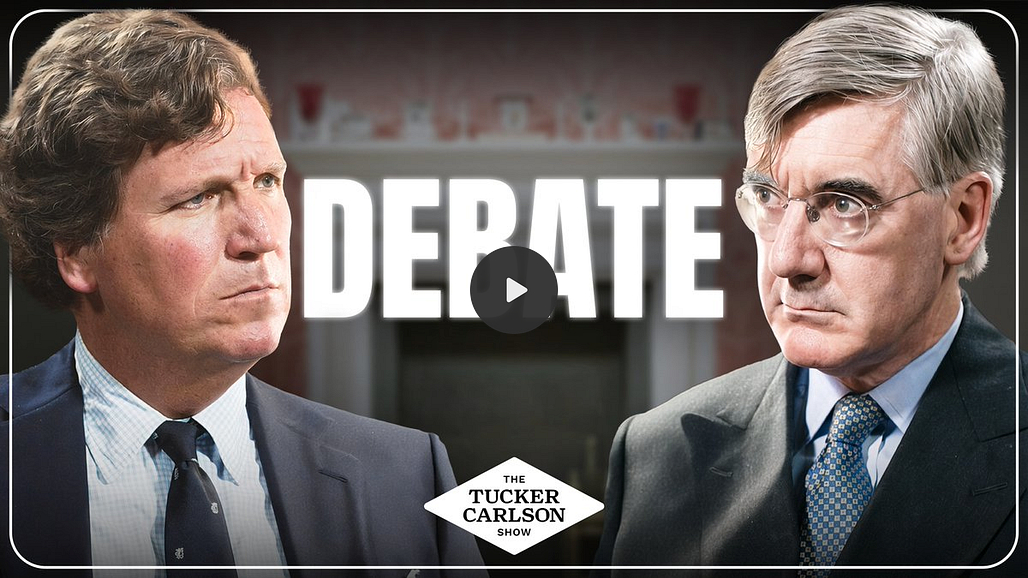
Carlson made no effort to correct much of the heavily rehearsed nonsense - particularly near the start of the interview when Mogg made the spectacular claim that Russia’s economic performance was nowhere near the UK’s stellar achievements (just have a look at the UK’s sovereign debt and compare it to Russia’s).
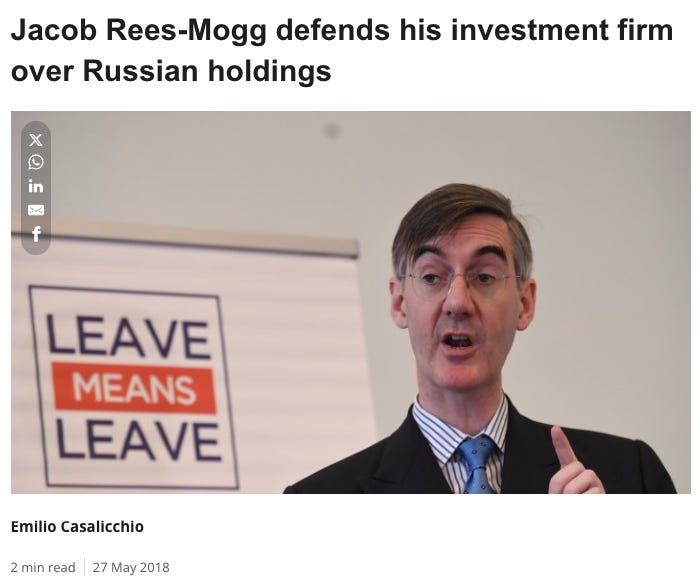
Mogg’s blatant hypocrisy could have been called out. The only conclusion one could take from the fact that it wasn’t is that Rees-Mogg has been selected for star treatment and that Carlson’s ‘interrogation’ was more of a publicity stunt for a politician who failed to win a mandate in 2024 - seeing his vote collapse.
Carlson could have explored this angle…
Rees-Mogg co-founded Somerset Capital Management (SCM) in 2007 and was fully involved in the firm’s overarching strategy until 2019.
SCM targeted emerging market assets - including Russian equities - from its early years. When questioned (at the time) about the firm’s £217 million exposure to Russia, Rees-Mogg argued that it would be “quite improper” and risk legal action from clients if he allowed his personal political viewpoints to dictate the portfolio managers’ stock selections.
However, Somerset Capital Management built up its main Russian investments across a timeline primarily spanning from 2012 to 2018 i.e. when Rees-Mogg remained a part-time adviser to the firm (until 2019). For example, SCM first purchased shares in the Russian internet giant Yandex in early 2015 while Rees-Mogg was serving as a formal adviser to the company.
Indeed, because Rees-Mogg was an advisor to the firm (as a Partner) he was paid £14,000 to £15,000 per month for his advisory services.
SCM’s largest and most controversial Russian holding was in the state-owned lender Sberbank. The firm took advantage of massive institutional stake sales in Russia - such as Sberbank’s major 2012 share privatization - to aggressively build out its exposure. By early 2018, SCM held a peak investment of roughly £60 million to £85 million (representing a 4.1% stake) in the bank.
So isn’t it odd that Rees-Mogg was an active advisor to a firm so heavily invested in Russia (as a lucrative emerging market) when he advocates that we prepare for war against a nation in which his firm was actively investing?
For another discussion of Rees-Mogg’s contrived aristocratic persona, this is worth a read.

Agreed, I only watched the first few minutes, and gave up when Tucker didn't put Jacob straight.