


If there’s a theme that’s evident on this site, I hope it’s this: that there’s a war being fought. Individual, free-thinking people are the combatants on one side. On the other side are the spin-merchants, the corporations, the NGOs, the governments, the owned media, the funds. Oh and people who haven’t developed the ability to think. So it can feel a bit frightening sometimes. Especially when people we considered free thinkers defect to the other side and then call us names. Or when people we considered defenders of freedom were working for the other side all along.
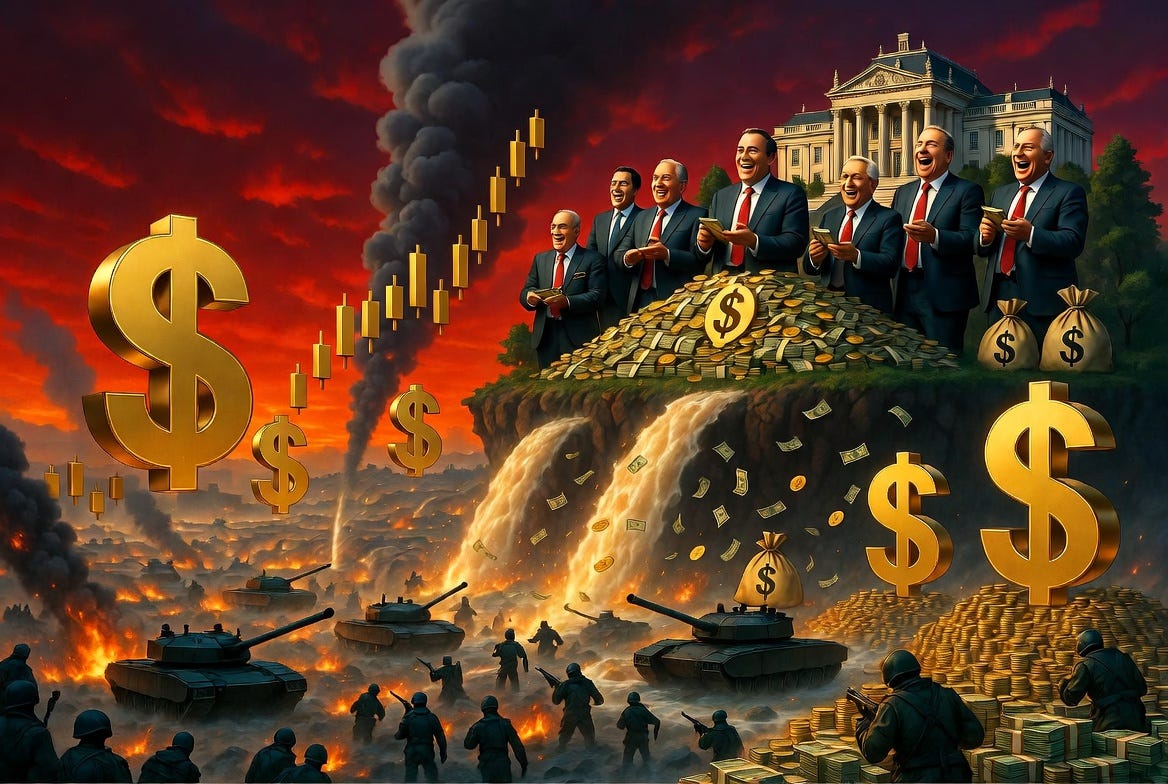
But we need to keep asking ourselves, if we truly are thinking straight (and free), what is the other side fighting for? And how does the fighting manifest itself?
That might seem a somewhat daft question when there are wars all over the place. But often the purpose of wars is not just about killing people (typically people just buying some bread or going to school). Wars are, increasingly, key components of obfuscation - hiding what’s actually going on. Wars are useful vehicles for division. They encourage people to take sides and argue for or against the various combatants. And why should such arguments be encouraged by the war-mongers? Because when we end up arguing about the wrong things we don’t get to see the big things, even when they should be really big and obvious. When we’re distracted we don’t see, we don’t understand.
Yesterday I reposted this piece by Morgan which highlighted the big thing that we’ve been forced to ignore in the unfolding ‘conflict’ in the Middle East. Her analysis has one central idea: that wars are typically about theft. And it’s the thieving that we’re not allowed to see.

Of course, the theft arising from modern warfare is complex in nature. These days theft - and I mean really big theft - is less about just snatching things, and more about deal-flow. The central premise that she presents is that one category of theft is to create property redevelopment opportunities by bombing places to smithereens that have already been earmarked for redevelopment anyway. In her analysis the game-play was developed around 9/11. Organise the demolition of the twin towers, then rebuild them with other people’s money. But pocket most of the assets in the process.
In the unfolding mess in the Middle East we have ‘Iranians” apparently bombing sweet shops in Tel Aviv while American fighter jets circle overhead. Meanwhile in Southern Lebanon RAF jets from Cyprus keep an eye on developments on the ground as ancient trade routes get reopened without those pesky villages harbouring “Hezbollah” militants. And Zones are created. Development Zones. And funds, it turns out, have already been raised for their redevelopment, just in time. Funny that.
Of course this isn’t the only game in town. But it neatly makes the point that modern warfare is not just about Palantir. It’s about people stealing stuff and using governments to grease the wheels of the process of thieving.
The other ‘big thing’ in the Middle East conflict is market rigging. With the ‘closing’ of the Straits of Hormuz, and the associated ‘panic’ in energy markets, the consequence has been a gift - and a grift - for the petrochemical companies. This was a leading news story today (about BP) on Twitter/X:
BP Profits Double to $3.2 Billion Amid US-Iran Oil War Surge. The British energy giant credited its windfall to strong oil trading and refining amid the war that began in early April 2026, with Brent crude spiking due to restricted flows.
Meanwhile we hear about deals being negotiated, even when the Iranian ‘regime’ is in tatters. But still, they negotiate. First Iran closes the Strait. Then America. We hear about tolls being levied. But perhaps the USA should be charging the Chinese tolls? Should the Chinese be paying tolls to the Americans? Should they be paying in bitcoin or in Tether? Are the Iranians accepting Tether? Isn’t the US Trade Secretary something to do with Tether? Wasn’t Epstein involved in Tether and that guy with the strange Thai name who used to fund Boris but now funds the Reform Party?
And so the war, it seems, is in some way related to oil company profits, and digital money, and who gets to pocket the tolls and who gets to control the critical bottlenecks. And why aren’t Russia and China complaining? Is this multipolarism in play?
Whatever the truth is we can be sure that it’s about asset theft. They have the guns after all.
There’s an anecdote that used to do the rounds during the ‘peace’ negotiations in Northern Ireland over which Tony Blair once presided. Rumour has it that a leader of a political party felt somewhat left out. The negotiations seemed to be focused on the hardliners. Blair is reputed to have said that the ones with the guns were the main players in the peace talks.
And so it is that the main players in the resolution of the Russia Ukraine War are the Americans and NATO negotiating with the ‘defence’ companies. After all, the only people who can deliver peace are those that provide the instruments of war. But there’s little incentive for any hurry. More dollars can be borrowed after all. More money can be printed. More villages need to be bombed to clear the way for this or that. And, remember, LNG is best transported by tanker. That’ll require new routes. New roads, new logistical partnerships. More exploration. Specialist skills. And everyone has to play their part. Iran has big LNG fields. Western companies can help them get those resources to market once the sanctions are lifted. That’s the prize. Funds can be created that will help. Infrastructure can be built.
That’s the deal flow, you see. There are deals to be done arising out of war. Stability can be achieved. But the people need to know that in building back better than before new structures need to be created that mean that we don’t lurch back to old ways. The old ways, you see, got us into the predicaments, the situations that create war.
As Craig Wright put it (on the other platform)...
We are in a war.
Not a metaphor, not a flourish, not an exaggeration uttered for effect — a war in the truest, starkest sense. A war for freedom. A war for humanity itself. A war in which the battlefield is invisible, the weapons are abstractions, and yet the consequences are more tangible than steel. This is a war over the future of ownership — the future of whether a man shall own himself or merely lease the illusion from those who presume to rule him.
The New Era is a reader supported publication. Please do subscribe to be notified about new posts.